
Two women can have the same operation, on the same list, with the same implants. For one, it’s cosmetic surgery. For the other, it’s medically necessary breast surgery. The technique doesn’t decide which is which. It’s decided by what the operation is correcting.
There’s a practical way to tell them apart in Australia. If the procedure attracts a Medicare item number and you meet the clinical criteria attached to it, it’s being treated as reconstructive. If it doesn’t, it’s cosmetic, and you pay the full cost yourself.
Key Takeaways
- Breast augmentation is cosmetic by default. It becomes reconstructive when it restores something that cancer, injury, disease or abnormal development has taken away.
- The three situations that most often shift breast augmentation out of the cosmetic category are reconstruction after breast cancer surgery, correcting a developmental abnormality, and correcting a problem caused by an earlier operation.
- Your surgeon assesses and documents the classification. It isn’t something you can request, and it isn’t decided by how strongly you feel about your appearance.
- Since 1 July 2023, cosmetic surgery requires a GP referral, two pre-operative consultations and screening for body dysmorphic disorder. Reconstructive surgery sits outside those specific rules but still needs a referral.
- Classification affects cost, the assessment process and the paperwork, so it’s worth understanding before your first appointment, not after.
Cosmetic or Reconstructive? What Separates Them
The Medical Board of Australia draws the line around one word: normal. Cosmetic surgery covers operations that revise or change the appearance, colour, texture, structure, or position of normal bodily features, where the dominant purpose is to achieve what the patient sees as a more desirable appearance.
Reconstructive surgery differs from cosmetic surgery in that, while it uses aesthetic techniques, it restores form and function, as well as the normality of appearance.
A breast that developed normally and is being enlarged is cosmetic work. A breast that was removed, never formed properly, or has been altered by a previous operation is a different clinical problem. That distinction is also why Medicare and plastic surgery is such a common source of confusion. People compare procedures when they should be comparing circumstances.
When is Breast Surgery Medically Necessary?
Three scenarios account for most cases where augmentation stops being cosmetic.
After Breast Cancer Surgery
Removing a breast, or part of one, removes normal tissue because of disease. Rebuilding it restores form and function.
Cancer Australia estimated 20,336 new breast cancer diagnoses across the country in 2025, including 20,129 in women, and five-year survival has improved from 75% in 1987–1991 to 93% in 2017–2021. More women are living long enough for reconstruction to matter.
Uptake has been climbing, too. Research drawing on the BreastSurgANZ Quality Audit found that the national post-mastectomy reconstruction rate rose from 12.8% in 2010 to 29% in 2019, averaging 21.3% across the decade.
Reconstruction can use implants, your own tissue, or a combination, and it can happen at the time of the cancer operation or years afterwards. Our guide to breast reconstruction after mastectomy covers how the implant-based pathway works.
When the Breast Never Developed Normally
Some breasts don’t develop along a typical path. Tubular breast deformity (also called tuberous breast) is one example. The breast base is constricted, the tissue herniates forward into the areola, and the shape is narrow and low rather than rounded. Adding volume alone doesn’t correct it; the constricted base has to be released and the breast footprint rebuilt, which is why this is reconstructive work even though implants are often involved.
Marked breast asymmetry surgery falls into the same category when the difference between sides is significant, rather than the mild unevenness almost everyone has.
Poland syndrome sits at the more pronounced end. It involves the absence or underdevelopment of the pectoralis major muscle on one side, usually with underdevelopment of the breast and nipple on that side, and sometimes hand differences.
When an Earlier Operation Needs Correcting
Implants aren’t permanent devices. Breast implants generally all need to be removed or replaced at some point, and the most common reasons for removal or replacement are capsular contracture, implant migration and implant rupture.
Capsular contracture is when your body forms a thin capsule of scar tissue around any implant. Sometimes that capsule tightens and hardens, which distorts the shape and can become painful.
The same applies to a ruptured implant, an implant that has shifted out of position, and to BIA-ALCL, a rare lymphoma that the TGA monitors through the Australian Breast Device Registry.
Where the problem is a complication, breast revision surgery is assessed clinically. Where someone simply wants a different size or shape, it’s cosmetic.
Who Decides What Counts as Medically Necessary Breast Surgery?
Your surgeon does, and they have to be able to justify it.
The assessment happens at consultation. It involves your history, an examination, measurements, and usually clinical photographs and imaging. All of it goes into your record, because the classification has to be defensible against the criteria that apply to the relevant Medicare item.
Classification isn’t negotiable, and it isn’t a favour. A surgeon who agrees to describe cosmetic surgery as reconstructive is misrepresenting a clinical record.
You’ll also need a referral before your first consultation. Under the guidelines that took effect in 2023, patients seeking cosmetic surgery must be referred by a medical practitioner who works independently of the practitioner performing the surgery, preferably their usual GP. For reconstructive work, a referral is required for any Medicare rebate to apply.
Bring your history with you. Operation reports from previous surgery, pathology results, imaging and any correspondence from your cancer team all help the assessment happen properly rather than over several appointments.
The Body Dysmorphia Screening Assessment
Since 1 July 2023, medical practitioners performing cosmetic procedures have been required to screen for body dysmorphic disorder during the consultation and assess whether the patient’s motivations and expectations are realistic.
Body dysmorphic disorder is a recognised mental health condition where a person becomes preoccupied with a perceived flaw in their appearance that others barely notice or don’t see at all. Surgery tends not to relieve that distress, which is why screening exists.
Where screening identifies underlying psychological issues, or where the patient is 18 or under and seeking a major procedure, an evaluation by a psychiatrist, psychologist or GP is required, and that practitioner must work independently of the surgeon. Our page on body dysmorphic disorder assessment sets out how this works at BB Clinic.
Reconstructive patients sit outside that specific requirement, but well-being is still part of the conversation. Deciding about reconstruction while you’re processing a cancer diagnosis is hard, and good care accounts for that.
What the 2023 Rules Mean for Medically Necessary Breast Surgery
The reforms that started on 1 July 2023 resulted from an independent review of cosmetic surgery regulation and tightened the pathway considerably.
Following referral, patients need a minimum of two pre-operative consultations, one of which must be in person with the practitioner who’ll perform the surgery. There are cooling-off periods, stricter advertising rules and clear requirements around disclosing qualifications. All surgery occurring on or after 1 July 2023 must comply with the 2023 guidelines, regardless of when it was booked.
There’s more detail in our summary of the new cosmetic surgery regulations.
Where To Start
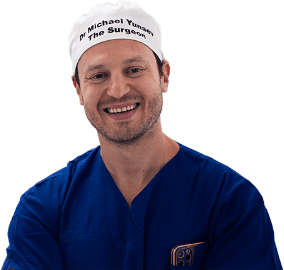
Thinking about whether your situation falls on the reconstructive side of the line? Dr Michael Yunaev is a Specialist Breast and General Surgeon and Fellow of the Royal Australasian College of Surgeons (FRACS) who works across both cancer and reconstructive breast surgery, which means the assessment, the documentation and the operation happen under one roof.
To discuss your circumstances with Dr Yunaev, call (02) 9819 7449 or book a consultation to have your circumstances assessed properly.







 Ask a Question
 Call Us
 Book a Consult