
Does Medicare cover excess skin removal after major weight loss? Yes, but only through four specific item numbers, and only two of them have anything to do with your abdomen. Search this question and you’ll find page after page about tummy tucks, as if excess skin only ever gathers in one place.
It doesn’t. It gathers on your arms, inner thighs, back, chest, and breasts, and Medicare treats each of those areas differently, with different item numbers, fees, and two completely different sets of eligibility rules.
Quick Answer
- Medicare rebates excess skin removal only when it’s assessed as medically necessary, never when it’s done for appearance alone. Surgery “solely for cosmetic reasons” is explicitly excluded.
- Four MBS items cover skin removal after weight loss: 30166 and 30177 for the abdomen, 30169 for one or two non-abdominal areas (arms, thighs, back, chest), and 30179 for circumferential body lifts.
- Breasts sit outside that group entirely, under Breast surgery (medically necessary) items such as 45558 and 45523.
- The two abdominal and circumferential items and the two “significant weight loss” items use different tests. One set asks for a skin condition that has failed three months of treatment. The other asks for at least five BMI points lost and six months of stable weight.
- The rebate covers the surgeon’s fee only, at 75% of the schedule fee for private patients in hospital.
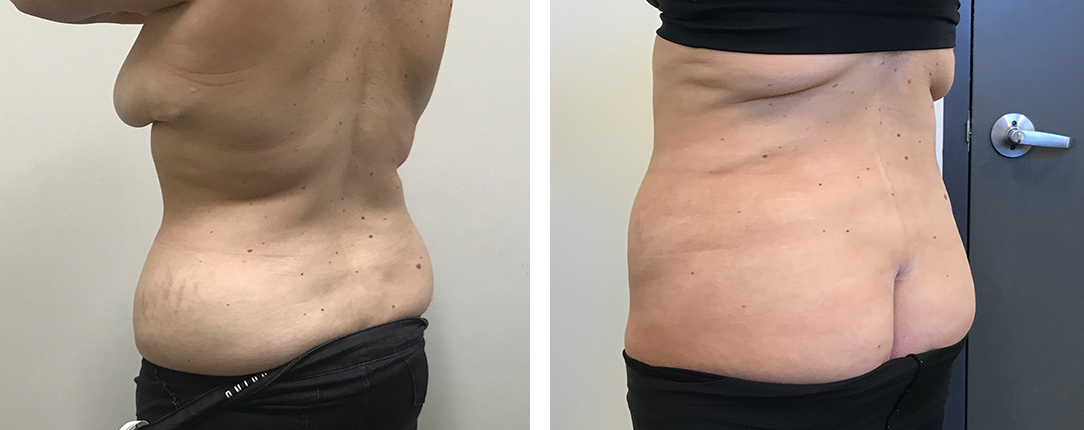
Does Medicare Cover Excess Skin Removal, or Just Subsidise It?
Medicare never pays your whole bill.
For a private patient in hospital, Medicare covers 75% of the schedule fee for the medical service. The schedule fee is the government’s set price, and it sits well below what any specialist surgeon in Sydney actually charges. On item 30177, the schedule fee is $1,179.70 and the Medicare benefit is $884.80.
Medicare also doesn’t touch private patient hospital costs, such as theatre fees, your bed, or your dressings. Those go to your health fund, or to you. Our breakdown of the cost of post-weight-loss surgery separates all three bills so you can see what an eligible item actually saves.
But an item number does two useful things beyond the rebate itself. It opens the door to a health fund contribution towards your hospital bill if you hold the right level of cover. And it makes the procedure GST-free, because medically necessary surgery isn’t taxed the way cosmetic surgery is.
Excess Skin Removal Medicare Item Numbers, Body Part by Body Part
All figures are current schedule fees as at 1 July 2026.
| Body area | MBS item | What it covers | Schedule fee | Medicare benefit (75%) |
| Abdomen (skin only) | 30166 | Wedge excision of redundant abdominal skin, no muscle repair | $897.70 | $673.30 |
| Abdomen (full) | 30177 | Lipectomy with radical abdominoplasty, with or without muscle repair | $1,179.70 | $884.80 |
| Arms, thighs, back, chest | 30169 | Non-abdominal skin removal, one or 2 areas | $718.15 | $538.65 |
| Whole trunk | 30179 | Circumferential (belt) lipectomy | $1,452.00 | $1,089.00 |
Sources: MBS Online, Department of Health, Disability and Ageing.
Medicare Item Number 30177: The Abdomen
Medicare item number 30177 covers lipectomy “in conjunction with a radical abdominoplasty, with or without repair of musculoaponeurotic layer and transposition of umbilicus”. Simply, removing the skin and fat, tightening the abdominal wall if needed, and repositioning the belly button.
That’s a full tummy tuck surgery with a functional indication. If your case is a straightforward skin excision without muscle work and umbilical transposition, item 30166 applies, and the fee drops by roughly $280. We’ve covered the abdomen in depth in our guide to Medicare and tummy tuck surgery.
Item 30169: Arms, Thighs, Back and Chest
Item 30169 covers “removal of redundant non-abdominal skin and lipectomy for functional problems following significant weight loss … one or 2 non-abdominal areas.”
So a brachioplasty (arm lift) and an inner thigh lift together fit under a single 30169 claim. Add a back or chest area, and you’ve exceeded what the item allows. There is no separate item for a third non-abdominal area since the lipectomy items were restructured on 1 July 2023. That changes how you sequence your operations, not just how you budget for them.
Our pages on Medicare and arm lift surgery and Medicare and thigh lift surgery go through each one.
Item 30179: When It Goes All the Way Around
If loose skin encircles your trunk (abdomen, hips, flanks, lower back), a circumferential or belt lipectomy under item 30179 offers the greatest benefit of the four, at $1,089.00.
It can be claimed with or without a radical abdominoplasty, but not with 30177 or 30166.
Breasts Are a Separate Conversation
Breast skin excess after weight loss doesn’t sit in the Weight loss surgery category at all. It falls under Breast surgery (medically necessary), and the criteria are unrelated to your weight loss.
Item 45558 covers correction of bilateral breast ptosis by mastopexy, and requires at least two-thirds of the breast tissue, including the nipple, to sit below the inframammary fold, documented with anterior and lateral photographs taken with a marker at the fold. It’s claimable once in your lifetime.
Item 45523 covers bilateral reduction mammaplasty for macromastia causing neck or shoulder pain.
Your breast surgery is assessed on its own evidence, not on your weight loss history. And because 45558 is once-per-lifetime, the order in which you stage your procedures matters more than most people realise.
Medicare Excess Skin Removal Eligibility: Two Different Tests
The four items do not share one set of criteria. They split into two.
Items 30177 and 30179 require all three of:
- The redundant skin is complicated by intertrigo (a rash in the skin folds) or another skin condition that risks loss of skin integrity, and it “has failed 3 months of conventional (or non-surgical) treatment”
- The redundant skin “interferes with the activities of daily living”
- Your weight “has been stable for at least 6 months following significant weight loss”
Items 30166 and 30169 require:
- Weight loss “equivalent to at least 5 body mass index points”
- Stable weight for at least six months before surgery
- Removal for functional problems
Five BMI points is a real number you can work out. If you’re 170cm tall, five BMI points is about 14.5kg. At 165cm, it’s around 13.6kg.
Item 30169 does not demand a three-month treatment record for the rash. Medicare excess skin removal eligibility for arms and thighs turns on weight loss and stability, not on dermatology. Which is why checking your excess skin removal Medicare eligibility area by area is worth doing before you rule anything out. You may not qualify for the abdominal item and still qualify for the non-abdominal one.
The exclusions matter too. Items 30166, 30169, 30177 and 30179 each carry a long list of items they can’t be billed with, including each other. You cannot stack them in one operation.

Start Your Documentation Three Months Before You Book
For items 30177 and 30179, the three-month record of failed non-surgical treatment has to already exist. It can’t be created retrospectively, and it can’t be assembled in the fortnight before surgery.
So the timeline runs backwards from your operation, not forwards from your consultation:
- Month zero. See your GP about the rash, the skin breakdown, and the chafing. Get it in the notes. Get a photograph.
- Months one to three. Follow the conservative treatment. Antifungal or barrier creams, drying agents, compression garments, and weight support. Return to your GP so each review is documented. Keep the prescriptions.
- Month three onward. The condition has persisted despite treatment, and there’s a written record proving it.
- Alongside all of it. Track your weight monthly so the six months of stability is evidenced, and dig out your highest recorded weight so the BMI change is calculable.
- Then consult. A specialist can now assess you against the current item descriptors with something to work from.
Eligibility is determined by Services Australia against the item descriptors, not by any clinic. No surgeon can promise you an item number. What a surgeon can do is assess you honestly against the wording and tell you which items, if any, your presentation fits.
What Medicare Won’t Pay For
- Liposuction alone. Contouring without skin excision doesn’t attract an item number in this context.
- Skin removal for appearance. If the skin isn’t causing a documented functional problem, no item applies, however much of it there is.
- A third non-abdominal area. Item 30169 stops at two.
- The hospital. Theatre, bed and accommodation are between you and your health fund.
- Revision surgery for a cosmetic result. Rebates follow function, not aesthetics.
Our overview of the Medicare rules for plastic surgery sets out how the same logic applies across other procedures.
Does Medicare Cover Excess Skin Removal Without Private Health Cover?
You can claim the rebate as a self-funded private patient. You just won’t have anyone covering the hospital side, which is the larger bill for body contouring.
Skin removal after weight loss falls under the weight loss surgery clinical category, and that category is only guaranteed under Gold-tier hospital policies. Silver and Bronze may include it. They aren’t required to.
If a breast procedure is part of your plan, check for “Breast surgery (medically necessary)” as a separate category on your policy.
Check whether you’ve served the twelve-month waiting period for pre-existing conditions, and (if you’re upgrading to Gold for this), that the waiting period runs from the upgrade date, not from when you first joined the fund.
The public system also treats functional cases, though waiting lists for skin removal are long and the criteria are applied strictly.
Where That Leaves You
Excess skin removal Medicare rebates are real, they’re modest, and they’re specific to the body part being treated. Get the item mapping right, start your documentation three months out, and you’ll know where you stand before you commit to anything.
Not sure which items your situation fits? Post-weight-loss surgery at BB Clinic starts with a proper assessment against the current MBS descriptors and an itemised written quote showing the surgeon, hospital, and anaesthetist fees separately, alongside any Medicare rebate you may be eligible for.
Dr Michael Yunaev is a Specialist Breast and General Surgeon (FRACS) with more than 22 years in breast and body surgery, consulting in Sydney. Call (02) 9819 7449 to arrange a consultation.
Frequently Asked Questions
This article is general information, not medical advice. All surgery carries risks and outcomes vary between individuals. Medicare eligibility is assessed by Services Australia against the criteria current at the time of your procedure. Schedule fees quoted are current as at 1 July 2026 and are indexed annually.










 Ask a Question
 Call Us
 Book a Consult