
Choosing between an implant and your own tissue for reconstruction is a decision many women face after a mastectomy diagnosis. Both are established breast reconstruction options in Australia, and neither is universally “better”. The right one depends on your body, your cancer treatment, and what matters most to you day to day.
This guide walks through how implant and flap-based reconstruction compare, what each involves, what breast reconstruction options cost in Australia and how Medicare fits in.
Quick Answer
- Implant reconstruction uses a silicone or saline implant, often after a tissue expander, and typically means one to two operations, a shorter recovery, and no second surgical site.
- Flap (autologous) reconstruction rebuilds the breast from your own tissue (most commonly from the abdomen (a DIEP flap) or back) and generally means longer surgery, a longer recovery, and a result that ages more naturally with your body.
- Radiotherapy is the deciding factor for many women. If radiation is planned or has already been given, flap reconstruction usually tolerates it better than an implant.
- Both are typically covered by Medicare when performed after a mastectomy for cancer or genetic risk, though private patients still usually face out-of-pocket costs.
- There’s no single right answer. Breast reconstruction surgery is planned around your anatomy, your oncology treatment plan, and your own priorities.
Comparing Implants vs Flap-Based Breast Reconstruction
Weighing up breast reconstruction options is easier with the two side by side. Here’s how implant and flap-based reconstruction generally compare across the factors women ask about most.
| Factor | Implant-based reconstruction | Flap (autologous) reconstruction |
|---|---|---|
| Number of operations | Usually 1–2 stages | Usually 1 main operation, plus later revisions |
| Surgery time | Around 1–3 hours | Around 4–8 hours |
| Hospital stay | 1–2 nights | 3–5 nights |
| Recovery before returning to work | About 3–4 weeks | About 6–8 weeks |
| Scarring | Mastectomy scar only | Mastectomy scar plus a donor-site scar |
| Feel and movement over time | Stays fairly constant; doesn’t fluctuate with weight change | Changes with your weight, more like natural breast tissue |
| Suitability for radiotherapy | Higher risk of hardening (capsular contracture) and shrinkage | Generally tolerates radiotherapy better |
| Long-term durability | Not a lifelong device – may need revision or replacement | Made from your own tissue, so it doesn’t wear out the way a device can |
| Donor tissue required | None | Enough spare tissue at a donor site (usually lower abdomen or back) |
These are general patterns, not guarantees. Your surgeon will talk through how each factor applies to your specific case.
What Is Implant-Based Breast Reconstruction?
Implant-based reconstruction rebuilds the breast mound using a silicone or saline implant, placed either under or in front of the chest muscle. It’s often done in two stages: a tissue expander is inserted first and gradually filled over several weeks, then swapped for the final implant once your skin has stretched enough. Some women are suitable for a single-stage, direct-to-implant approach instead.
The main appeal is a simpler recovery. There’s no second surgical site, the operation itself is shorter, and most women are back to light activity within weeks. Fat grafting (using liposuction to harvest a small amount of your own fat and transfer it to smooth the contour) is sometimes added later for a more natural result. You can read more about implant-based reconstruction after mastectomy if this option looks like a fit.
The trade-off is that an implant is a device, not living tissue. Both saline and silicone implants carry a small annual risk of rupture or leak, and most women will need at least one revision surgery over their lifetime.
What Is Flap-Based (Autologous) Breast Reconstruction?
Autologous breast reconstruction (“autologous” simply means using your own tissue rather than a foreign device) rebuilds the breast using skin, fat and sometimes muscle taken from another part of your body. The tissue is either kept attached to its original blood supply and tunnelled into place (a pedicled flap) or fully disconnected and reattached to blood vessels near the chest under a microscope (a free flap).
Because the reconstructed breast is made from your own tissue, it tends to look and feel more natural, and it changes with your body over time, the way a natural breast would. It also generally holds up better against radiotherapy than an implant does. The trade-offs are a longer, more technically demanding operation, a scar and some numbness at the donor site, and a longer overall recovery.
DIEP Flap Breast Reconstruction Explained
The most common form of autologous breast reconstruction in Australia is DIEP flap breast reconstruction, short for Deep Inferior Epigastric Perforator flap. It uses skin and fat from the lower abdomen, while sparing the underlying abdominal muscle. That muscle-sparing means a faster recovery and a lower risk of abdominal wall weakness than older techniques like the TRAM flap, which took muscle along with the tissue.
Other donor sites are used when the abdomen isn’t suitable, including the back (a latissimus dorsi flap) or the buttocks and thighs. A large systematic review of over 14,000 patients published in the National Library of Medicine found that flap reconstruction, including DIEP, was associated with higher long-term patient satisfaction and better psychological well-being than implants, but also with a higher rate of complications, such as wound-healing issues and infection. Your own outcome depends on your anatomy, your surgeon’s experience and how your body heals.
Why Radiotherapy Changes the Decision
If radiotherapy is part of your treatment, it’s often the single biggest factor in choosing between reconstruction options. Radiation changes the tissue it touches, and a reconstructed breast that receives radiotherapy is at a higher risk of complications, no matter which method you choose.
For implants, radiotherapy increases the risk of capsular contracture (hardening of the scar tissue around the implant) and visible shrinkage or distortion over time. For this reason, many Australian breast surgeons are cautious about placing a definitive implant before radiotherapy, and often prefer to keep a temporary tissue expander in place until radiotherapy is finished, then reconstruct afterwards.
Flap reconstruction generally tolerates radiotherapy better because living, well-vascularised tissue heals and adapts more like normal skin. Even so, many surgeons still prefer to complete radiotherapy first and delay the definitive flap reconstruction by around six months, giving irradiated tissue time to settle before it’s operated on. If you know radiotherapy is likely, raising this early with your surgical team gives you the most options.
If you’re still in the diagnosis and treatment-planning stage, our breast cancer treatment page explains how mastectomy and reconstruction fit around chemotherapy and radiotherapy. Some women are also candidates for a nipple-sparing mastectomy, which preserves the nipple and skin envelope and can simplify reconstruction with either method.
Breast Reconstruction Options and Medicare in Australia
Breast reconstruction following a mastectomy for cancer or a genetic risk (such as a BRCA mutation) is classified as reconstructive surgery, not cosmetic surgery. Medicare doesn’t cover cosmetic procedures but does provide rebates for reconstructive ones with a valid Medicare Benefits Schedule (MBS) item number. Implant-based reconstruction using a permanent prosthesis is listed under MBS item 45527, and autologous breast reconstruction is listed under items 45530 and 45531, depending on whether it’s unilateral or bilateral, with DIEP flap raising specifically covered under MBS item 45538.
Having an item number doesn’t mean the surgery is free. In the public hospital system, reconstruction is provided at no cost under Medicare, but waiting times can be long. A national Breast Cancer Network Australia survey found that 27% of women waited longer than a year for reconstruction through the public system. Going private avoids the wait but shifts the cost. Typical specialists’ fees for private-patient breast reconstruction with tissue expansion are around $5,700, with Medicare and private health insurance together covering most (but not all) of that, plus separate hospital fees. One in five women having reconstruction privately faced out-of-pocket costs of more than $10,000, with DIEP and other flap procedures (which involve two operating sites and often two surgical teams) generally sitting at the higher end of that range.
If you’d like a clear breakdown of how Medicare, private health cover, and out-of-pocket costs apply to your situation, breast reconstruction surgery consultations at BB Clinic include a written quote outlining expected rebates and gap costs before you decide on anything.
How to Choose Between Implants and Flap Reconstruction
There’s rarely one obviously correct answer, but a few practical questions tend to point women toward one option over the other.
Implant-based reconstruction may suit you better if you:
- Want a shorter operation and a faster initial recovery
- Would prefer to avoid a second scar or donor site elsewhere on your body
- Have limited spare tissue on your abdomen or back
- Are having both breasts reconstructed and want a simpler, more symmetrical result
- Aren’t expected to need radiotherapy
Flap-based (autologous) reconstruction may suit you better if you:
- Want a breast made from your own tissue that looks and ages naturally
- Are likely to need, or have already had, radiotherapy
- Have enough donor tissue at the abdomen or back
- Are prepared to accept a longer operation and recovery in exchange for a more durable result
- Would prefer to avoid a device that may need future revision
Some women also combine approaches over time, starting with an implant and later adding breast augmentation with fat transfer for contour refinement, since fat grafting can improve the results of either reconstruction method. You can read more about why we use fat grafting as part of a broader reconstruction plan.
Get Expert Support and Advice On The Right Approach For You
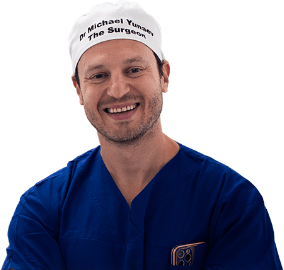
Still weighing up which path fits your situation? A private consultation with Dr Michael Yunaev at BB Clinic is the most reliable way to find out, with your anatomy, cancer treatment and priorities assessed in person rather than guessed at from an article.
Book a consultation to talk through your breast reconstruction options and get a written quote before you decide on anything.
Frequently Asked Questions
Is DIEP flap breast reconstruction more painful than implant reconstruction?
Recovery from DIEP flap surgery involves discomfort at both the abdominal donor site and the chest, so the early recovery period is generally more demanding than after implant reconstruction. Most women manage this with standard pain relief, and discomfort settles significantly within the first few weeks.
Can I switch from an implant to flap reconstruction later?
Yes. It’s common for women who started with an implant, particularly before or during radiotherapy, to convert to a flap reconstruction afterwards. Delayed autologous breast reconstruction is a well-established option and can be performed months or years after your original surgery.
Do flap reconstructions last longer than implants?
Because a flap is made from your own living tissue, it doesn’t carry the same rupture or replacement risk as an implant, which has a small annual failure rate and often needs revision over a lifetime. A flap can still change shape with significant fluctuations in weight, however.
Will Medicare cover a DIEP flap if I’ve already had implant reconstruction?
Generally yes, provided the original surgery was for reconstructive rather than cosmetic reasons and you meet the criteria for the relevant MBS item. Your surgeon can confirm which item number applies before your revision surgery.
How do I know which option I’m actually a candidate for?
This depends on factors only a surgeon can properly assess: your remaining donor tissue, your cancer treatment plan, your general health, and your own priorities. A detailed consultation is the only reliable way to find out which breast reconstruction options are realistically open to you.









 Ask a Question
 Call Us
 Book a Consult