
Your inner thigh incision sits in the groin crease; the exact spot that folds every time you sit, stand, climb a step or roll over in bed. That’s what separates thighplasty recovery from a tummy tuck or an arm lift. The scar is placed in a hinge, and for the first fortnight, almost every movement you make asks that hinge to open and close.
Most recovery guides give you a calendar. Fewer explain how to actually get off the toilet on day three without pulling on your stitches. This one covers how to move, how to sit, and how to sleep, and why the swelling in your legs behaves differently from swelling anywhere else on your body.
Key Insights
- The groin incision is the reason mobility feels so restricted early on. Bending your hip past roughly 90 degrees puts direct tension on the wound.
- Short, frequent walks usually start within a day or two of surgery and are capped at a few minutes at a time. Distance builds gradually over the first three to four weeks.
- Leg swelling is common and often outlasts that from other body-contouring procedures.
- Elevation, compression and gentle movement are the three levers you control. Lymphatic massage may help comfort, though the evidence is mixed.
- Typical ranges: 2–3 weeks off desk work, 4–6 weeks for physical jobs, 6–8 weeks before strenuous exercise. Your surgeon’s timeline overrides all of it.
Why the Groin Incision Changes This Recovery
An inner (medial) thigh lift places the incision in the groin crease, running from the inner thigh toward the buttock crease. Some patients also need a vertical incision extending down toward the knee.
That groin placement helps to hide the scar under underwear and swimwear. But it also means the wound sits across your hip flexor, in a warm, moist area that moves constantly and is difficult to keep dry.
This makes wound healing problems the most common issue after this operation. Every instruction you’re given about movement traces back to one goal: keep tension off that incision while it knits.
How You’ll Actually Move in the First Two Weeks
Getting In and Out of Bed
Roll, don’t sit up. Lying on your back, bend your knees slightly and roll your whole body to one side, keeping your knees together so your thighs don’t separate. Then push up with your arms while letting your legs swing down off the edge of the bed.
Sitting straight up from flat forces your hips into deep flexion and puts direct pressure on the groin wound. The log-roll avoids that entirely.
Getting back in is the same sequence in reverse: sit on the edge, lower your torso sideways onto your elbow, then lift both legs up together.
Sitting Down and Standing Up
Sit tall and shallow. A firm dining chair is better than a soft lounge, because sinking into cushions closes your hip angle past the point where the incision starts to complain.
Keep your knees at roughly hip height or slightly lower. Raising the seat with a folded towel or firm cushion helps. Toilets are the common sticking point. Many patients find a raised toilet seat frame makes the first fortnight substantially easier.
When you stand, shuffle forward to the edge of the seat first, then push up through your arms and legs together rather than folding forward at the hips.
Stairs
Take them one step at a time, both feet landing on each tread before you move on. Going up, lead with your stronger leg. Coming down, lead with the other.
Hold the rail. Stairs demand more hip flexion than flat walking, so most patients find them tiring for the first two to three weeks. If you have a choice, set up your recovery space on one level.
Walking
Short and often beats long and occasional. Many surgeons have patients up and moving within hours of surgery, starting with a few minutes around the house every hour or two while awake.
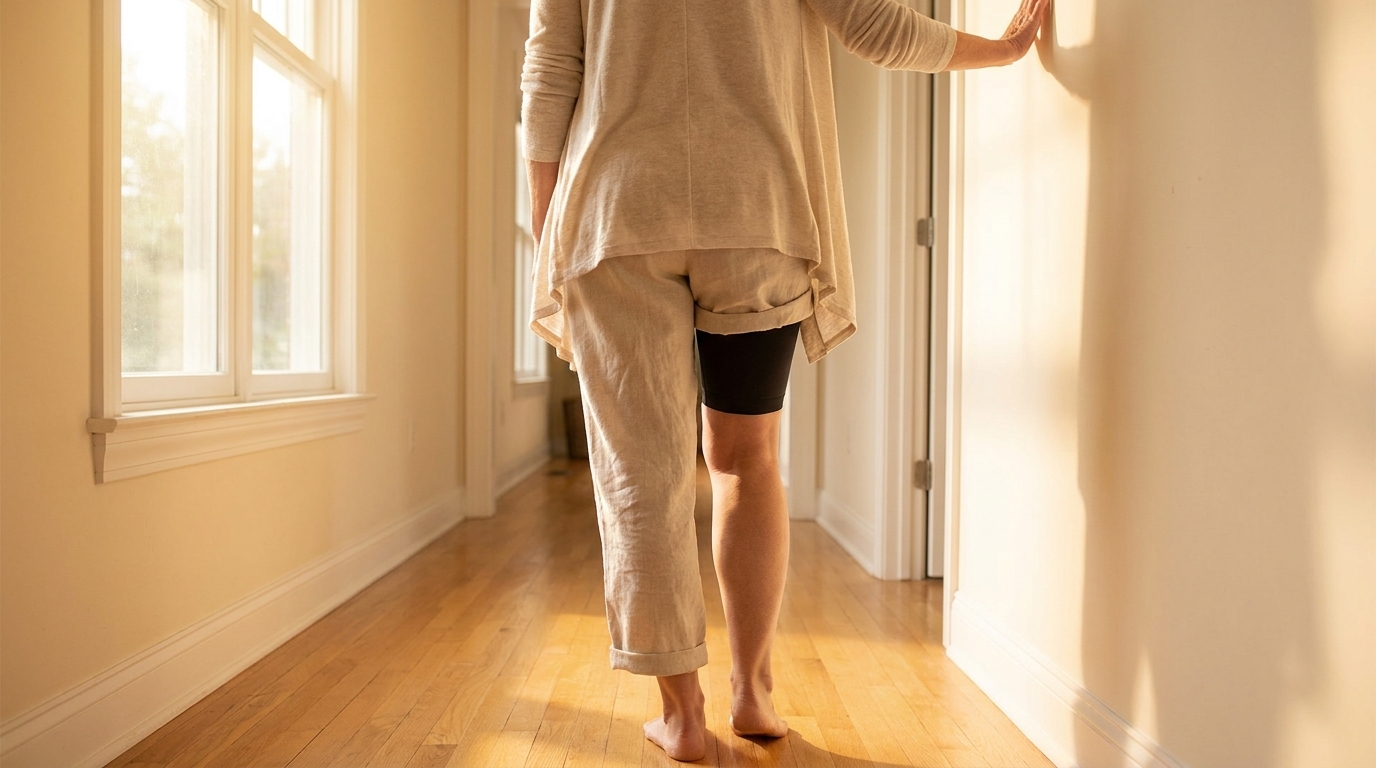
Your gait will feel odd; wide, stiff, a bit like you’ve been riding a horse. That’s normal. Swelling and tightness through the inner thigh change how your hips track.
Over the first fortnight, most patients build up to a few minutes, then short walks around the block. Time is a better measure than distance: capping walks at around 10–15 minutes in the second week is a common approach. Pushing into pain risks widening the wound.
Hip Movement and What to Avoid
For roughly four to six weeks, treat these as off-limits unless cleared:
- Squatting, deep lunges, or crouching to pick things up
- Sitting cross-legged or with knees splayed apart
- Wide steps (like getting into a high car or over a bath edge)
- Anything that stretches the inner thigh, including yoga poses
- Lifting anything heavier than a full kettle
Keeping your knees together during any transfer is the single habit worth drilling into muscle memory before surgery.
Why Your Legs Swell More Than You Expect
Swelling after thighplasty tends to be more stubborn than after abdominal or arm surgery for mechanical reasons.
The lymphatic vessels that drain your legs run up through the inner thigh and groin. Surgery in that corridor temporarily disrupts some of those drainage pathways. Fluid still arrives in the leg through your arteries, but it has fewer efficient routes back out, so it pools, and gravity pulls it downward into your calves, ankles and feet.
That’s why you can have a flat, tight thigh and puffy ankles at the same time.
Most patients see meaningful improvement across the first six weeks, with residual swelling settling over three to six months. The final contour is generally assessed at 6 months or later.
Managing Swelling: The Three Levers You Control
Elevation
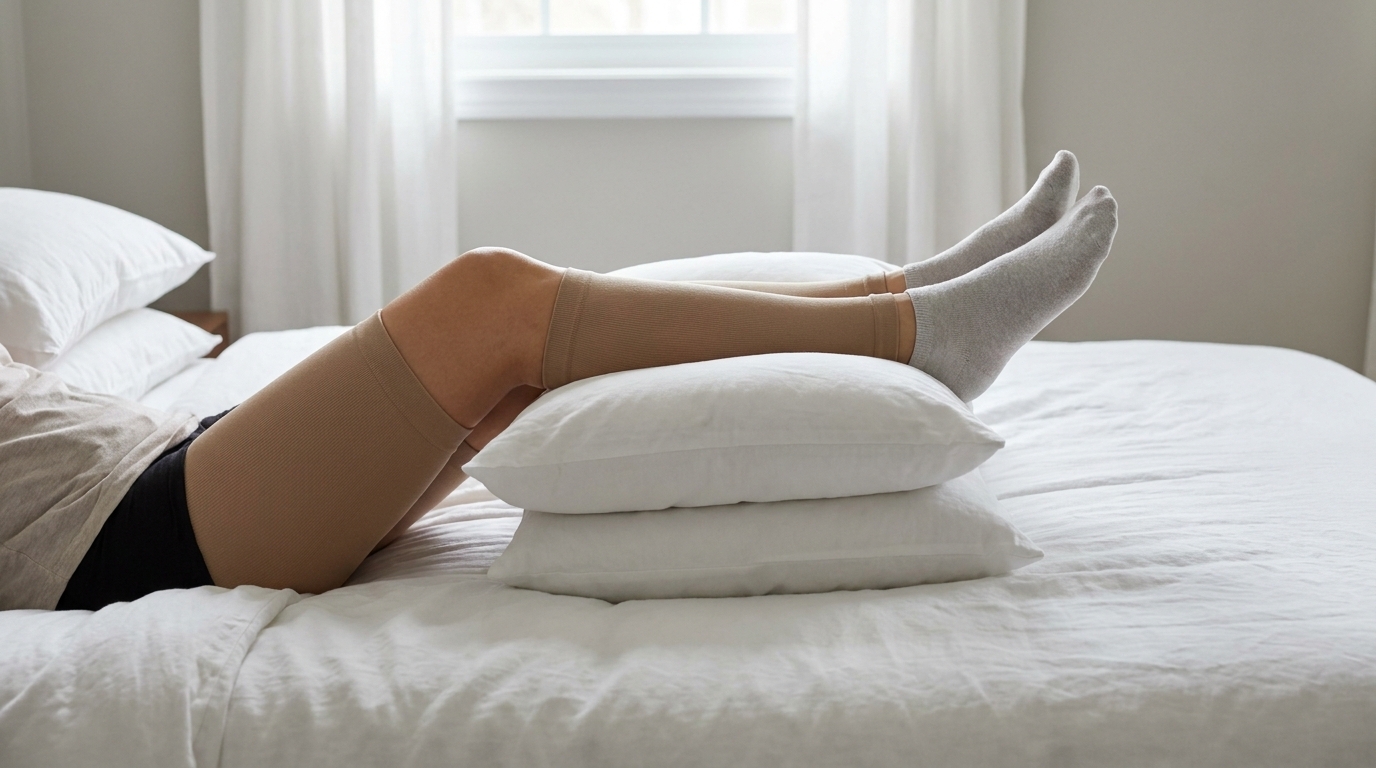
The most underused tool in thigh lift recovery. Getting your legs above heart level lets gravity work in your favour rather than against you.
Lie flat on your back with your legs propped on two or three firm pillows, so your ankles sit higher than your hips. Aim for 15–20 minutes several times a day, particularly after any walking.
Don’t prop pillows directly under your knees, as it will bend your hips and knees and can restrict blood flow rather than help it. Support the full length of the calf instead.
Sitting with your feet on a footstool doesn’t count. Your feet need to be above your heart.
Ankle Pumps and the Calf Muscle Pump
Blood in your leg veins doesn’t move upward on its own. Blood flow through the leg veins generally relies on the calf muscles: when they contract, they squeeze the veins, pushing blood upward toward the heart against gravity.
Point your toes down, then flex them up toward your shin. Ten to twenty repetitions every hour while you’re awake. It costs nothing, doesn’t touch your incision, and both moves fluid and supports circulation.
Reduced movement after surgery raises the risk of blood clots in the deep leg veins. Your surgical team will have a plan for you, which may include compression stockings, calf pumps, or blood-thinning medication.
Compression Garments
Your garment does two jobs: it applies external pressure to limit fluid accumulation in the tissue, and it holds the newly tightened skin against the underlying tissue as everything adheres.
Expect to wear it around the clock initially, then part-time as swelling settles. Total wear is commonly measured in months rather than weeks, and some surgeons recommend continuing to wear it at night well beyond the three-month mark.
A few things patients wish they’d known:
- Buy a second garment. Washing takes a day to dry, and you’ll want a clean one.
- Roll it on like a stocking rather than pulling it up in stages.
- If it digs into the groin crease or cuts a red line into your skin, tell your clinic. A garment that bunches at the incision can contribute to wound breakdown.
Lymphatic Massage
Manual lymphatic drainage is widely offered after body contouring surgery, and many patients find it comfortable and reassuring.
It may help you feel better and ease discomfort and tightness. It isn’t a substitute for elevation, compression and movement, which cost nothing and have clearer mechanical logic behind them. If you want to try it, ask your surgeon when it’s safe to start.
Returning to Normal Activities
These are typical ranges, not promises. Your surgeon’s assessment of your healing is what matters.
| Activity | Common timeframe |
| Short walks indoors | Within 1–2 days |
| Showering | Usually 48 hours to 1 week, per your surgeon |
| Desk work | 2–3 weeks |
| Driving | Around 2–3 weeks, and only once off strong pain medication |
| Physical or manual work | 4–6 weeks |
| Strenuous exercise, running, gym | 6–8 weeks minimum |
| Swimming | Once incisions are fully healed, often 6+ weeks |
| Final contour visible | 6–12 months |
Warning Signs Worth a Phone Call
Contact your surgical team promptly if you notice:
- Swelling in one leg is noticeably worse than the other, especially with calf pain, warmth or redness
- Increasing pain rather than gradually decreasing pain
- Fever, or wound discharge that’s cloudy or foul-smelling
- A wound edge that separates or opens
- A soft, fluid-filled bulge under the skin
- Shortness of breath or chest pain. Seek emergency care immediately
Asking early is always better than waiting to see. Minor wound separation is common after this operation and is far easier to manage when caught in the first day or two.
Planning Ahead Makes the Difference
The patients who find this recovery most manageable are usually the ones who set up before surgery. A firm chair, a raised toilet seat, a second garment, pillows for elevation, and someone at home for the first few days are all worth prepping early.
If you’re weighing up whether this is the right procedure for you, our guides on thigh lift suitability and the cost of thigh lift surgery cover the decision itself. For patients who’ve had major weight loss, thighplasty is often part of a staged plan, alongside surgery after weight loss and treatment for loose skin on the arms.
Considering thighplasty surgery in Sydney, or already booked and want a clearer picture of your recovery? Dr Michael Yunaev is a Specialist Breast and General Surgeon and Fellow of the Royal Australasian College of Surgeons with more than 22 years of surgical experience. At a consultation, he’ll assess your skin laxity, explain which technique suits your anatomy, and walk you through what your specific recovery is likely to involve.
Call (02) 9819 7449 to arrange a consultation.
This article provides general information only and isn’t a substitute for personalised medical advice. All surgery carries risks, and individual results and recovery vary. Discuss your circumstances with a qualified surgeon.










 Ask a Question
 Call Us
 Book a Consult