
If you’ve noticed your breasts sitting lower than they used to, or the shape has changed after pregnancy, weight loss, or simply getting older, you’re not alone. Breast drooping, or ptosis, is incredibly common. It can present at any age and in any breast size, and is commonly associated with ageing, significant weight loss, pregnancy, and hormonal changes.
The question most women come to us with isn’t whether they want to do something about it, but what to do. Is a surgical breast lift the right choice, or can a non-surgical approach get the job done?
The answer is that it depends on how much the breast has drooped, and what result you’re hoping for.
What Is Breast Ptosis?
“Ptosis” simply means drooping. Surgeons use a grading system to assess how much the breast has dropped by measuring where the nipple sits relative to the breast fold (the crease underneath your breast).
There are three grades:
- Grade I (Mild): The nipple sits at the level of the breast fold.
- Grade II (Moderate): The nipple sits below the breast fold, but isn’t the lowest point of the breast.
- Grade III (Severe): The nipple sits below the breast fold, points downward, and is the lowest point of the breast.
There’s also what’s called pseudoptosis, where the nipple itself is in a reasonable position, but the breast tissue has deflated and sagged below the fold. This is common after pregnancy and breastfeeding.
Understanding your grade matters enormously, because it’s the biggest factor in determining which approach will actually work.
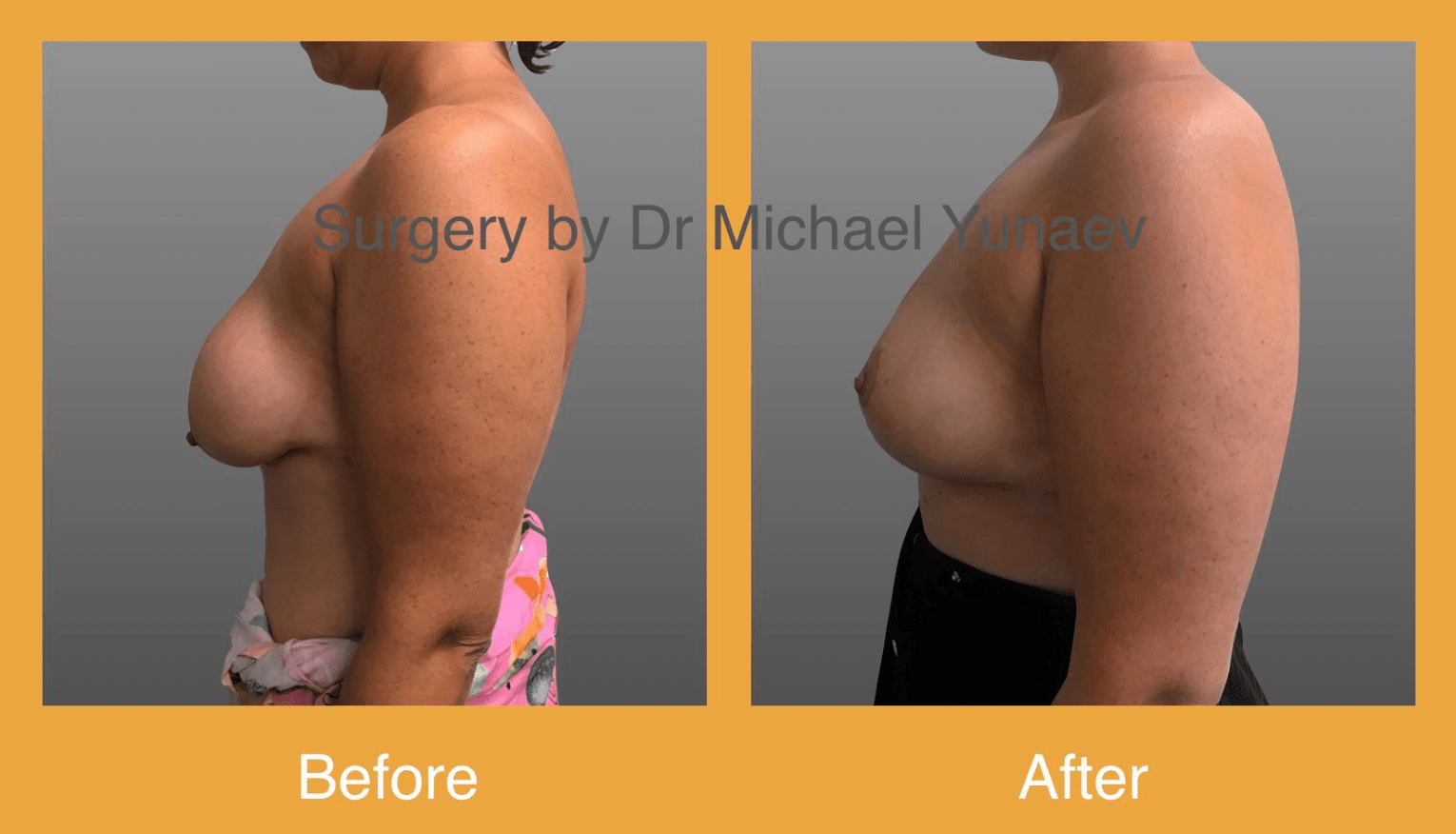
Why Do Breasts Sag in the First Place?
Breast tissue is supported by Cooper’s ligaments, fibrous structures that connect the breast to the overlying skin and underlying chest wall. Over time, those ligaments stretch and weaken, the skin loses its elasticity, and the breast gradually descends.
The main contributing factors to sagging breasts are the number of pregnancies, smoking history, significant weight gain or loss, higher BMI, and larger bra cup size. Where weight loss is the driver, timing matters: losing more weight after a lift can undo the result, so most surgeons wait until you’re stable.
What Does a Surgical Breast Lift (Mastopexy) Do?
A surgical breast lift reshapes and repositions the breast. The surgeon removes excess, stretched skin, repositions the nipple and areola to a higher, more youthful position, and reshapes the remaining breast tissue for a firmer, rounder contour.
Depending on the degree of ptosis, the technique and the incision pattern will vary. Vertical, anchor and periareolar patterns each suit a different grade, and how surgeons choose between incision patterns comes down to how far the nipple has dropped. Your surgeon will advise which is appropriate. The goal is always to balance the result with the least scar burden possible for your situation.
Key points about surgical mastopexy:
- Addresses all grades of ptosis, including severe cases where the nipple has descended significantly
- Can be combined with breast implants or fat transfer if you also want to restore lost volume
- Results are long-lasting, though not permanent. Future pregnancies and significant weight changes will affect the outcome
- Recovery is typically 1–2 weeks before returning to light activity, with a longer period before strenuous exercise
- Scarring is permanent, though it fades significantly over 12–18 months and is typically positioned to be concealed in a bra
A mastopexy is the only way to physically reposition the nipple and remove excess skin. No non-surgical technology can replicate this. Not every lift needs added volume; whether you need implants with a lift depends on how much breast tissue you have to work with.

What Can Non-Surgical Options Do?
Non-surgical breast-lifting treatments (such as radiofrequency (RF), high-intensity focused ultrasound (HIFU), and similar energy-based technologies) work by heating the deeper layers of skin and tissue to stimulate collagen production. The result is gradual skin tightening and a subtle lift.
If your ptosis is mild (Grade I) and your main concern is skin laxity and early looseness rather than significant drooping, these treatments can offer a meaningful improvement. They’re also a reasonable option for someone who wants to maintain results after a surgical lift.
Non-surgical approaches are best suited to mild to moderate sagging where the goal is a natural, gradual improvement. They cannot correct severe ptosis, reposition the nipple-areola complex, or remove excess skin. Once ptosis is significant the limits are structural, which is why energy-based devices can’t replace surgery.
What non-surgical options offer:
- No anaesthesia, no incisions, limited downtime
- Gradual results, improving over several months as collagen remodels
- Multiple sessions are typically needed, with maintenance treatments required to sustain the effect
- Best for early-stage ptosis, skin firmness, or subtle improvement
The most important thing to understand is that non-surgical treatments tighten skin. Surgery reshapes breast tissue. Those are two very different outcomes, and one cannot substitute for the other once drooping reaches a moderate or severe level.
Which One Is Right for You? A Practical Guide
| Surgical Breast Lift | Non-Surgical Options | |
| Best for | Grade II–III ptosis; significant drooping; nipple repositioning needed | Grade I ptosis; early skin laxity; maintenance |
| Results | Dramatic and long-lasting | Subtle and gradual |
| Downtime | 1–2 weeks | None |
| Longevity | Years | 12–18 months typically; needs maintenance |
| Nipple repositioning | Yes | No |
| Excess skin removal | Yes | No |
| Scarring | Yes (fades over time) | No |
Find The Right Way Forward
Non-surgical treatments can be valuable, but they’re often marketed in ways that set expectations well beyond what they can deliver. If you’ve seen claims about dramatic before-and-after results from a cream, device, or injection, be sceptical. No topical product or non-invasive treatment can remove excess skin or move a nipple that has descended significantly.
Surgery carries real considerations too, and it’s not the right answer for everyone. Cost is part of that too, and what a lift costs with and without a rebate varies more than most patients expect. A small number of patients meet the criteria, and when a lift qualifies for a Medicare rebate usually turns on documented skin irritation. At the BB Clinic Sydney breast clinic, our role is to help you understand your options clearly, without pressure, so you can make a decision that genuinely fits your body, lifestyle, and goals.
If you’d like to talk through what’s right for you, we’d love to hear from you. Book a consultation with Dr Yunaev on (02) 9819 7449 or reach us at info@bbclinic.com.au.









 Ask a Question
 Call Us
 Book a Consult